


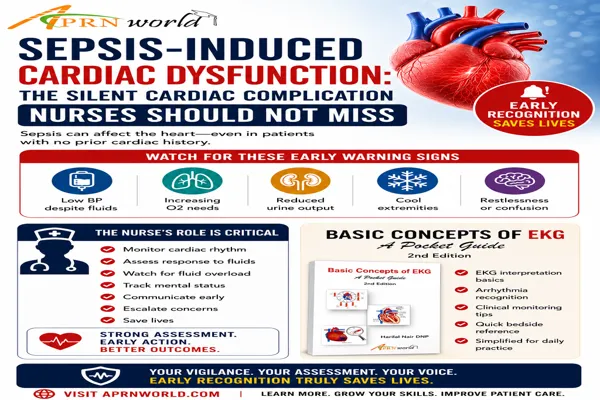
Sepsis-Induced Cardiac Dysfunction: The Silent Cardiac Complication Nurses Should Not Miss
As nurses, we know that sepsis can change a patient’s condition within minutes. A patient who initially appears stable may suddenly develop worsening hypotension, increasing oxygen requirements, altered mental status, or signs of poor perfusion despite ongoing treatment. In many cases, one serious complication may already be developing silently in the background,Sepsis-Induced Cardiac Dysfunction (SICD).
Some of the most dangerous patient deteriorations begin with subtle changes at the bedside. Sometimes it is not one dramatic symptom that raises concern, but a gradual pattern:
Persistent tachycardia
Blood pressure remaining low despite fluids
Increasing respiratory distress
New arrhythmias
Reduced urine output
Cool extremities
Restlessness or confusion
These small clinical changes may indicate that the heart is beginning to struggle during sepsis.
Sepsis-Induced Cardiac Dysfunction occurs when the body’s overwhelming inflammatory response to infection affects the heart’s ability to pump effectively. Even patients without a previous cardiac history can develop temporary myocardial dysfunction during severe sepsis or septic shock.
Recent studies suggest that cardiac dysfunction may occur in nearly 40–60% of septic shock patients. Researchers have also found that delayed recognition is associated with:
Longer ICU stays
Increased vasopressor requirements
Higher mortality risk
Greater need for ventilatory support
The challenge is that many symptoms overlap with sepsis itself, making early recognition difficult unless clinicians remain highly vigilant.
Experienced nurses are often the first to notice when “something just doesn’t look right.”
Once a septic patient admitted with severe pneumonia and hypotension. Initially, the patient responded to fluids and vasopressors. However, throughout the shift, oxygen demand increased, crackles developed after additional fluid administration, and the patient became increasingly tachycardic and restless.
At first, the symptoms appeared to be worsening sepsis alone. But further evaluation later revealed impaired cardiac function related to sepsis-induced myocardial dysfunction.
Looking back, the early warning signs had already been there:
Poor tolerance to fluids
Worsening respiratory status
Persistent tachycardia
Signs of poor perfusion
So continuous reassessment is truly important in septic patients.
In sepsis management, aggressive fluid resuscitation is often necessary to restore perfusion. However, when cardiac dysfunction develops, excessive fluids may worsen pulmonary edema and respiratory compromise.
This is why bedside reassessment remains essential throughout treatment.
Nurses play a major role in identifying:
Changes in cardiac rhythm
Poor response to fluids
Increasing oxygen requirements
Signs of fluid overload
Worsening hemodynamic instability
Altered mental status
Declining urine output
Early communication with the healthcare team can prompt additional evaluation such as:
EKG monitoring
Bedside echocardiography
Troponin and BNP testing
Hemodynamic monitoring
Vasopressor or inotropic adjustments
The Importance of EKG Monitoring in Sepsis
Cardiac rhythm monitoring is especially important in septic patients because electrolyte imbalances, hypoxia, inflammation, and myocardial stress can increase the risk of arrhythmias and conduction abnormalities.
Subtle EKG changes may sometimes appear before severe clinical deterioration occurs. Recognizing rhythm abnormalities early can help providers intervene sooner and prevent complications.
For nurses, students, NPs, PAs, and healthcare professionals looking to strengthen their cardiac assessment skills, Basic Concepts of EKG – A Pocket Guide 2nd Edition offered by APRN World and available through Amazon is a practical and easy-to-use clinical reference designed for fast-paced healthcare settings.
The APRN World EKG Pocket Guide includes:
Common cardiac rhythms
EKG interpretation basics
Arrhythmia recognition
Clinical monitoring tips
Quick bedside reference tools
Simplified learning for daily practice
Whether working in emergency care, ICU, telemetry, or bedside nursing, strong EKG interpretation skills can help clinicians identify subtle cardiac changes earlier during conditions like sepsis and septic shock.
Continuing Education Improves Patient Outcomes
Critical care nursing requires continuous learning. As evidence-based practices evolve, staying updated with cardiac monitoring, hemodynamic assessment, and emergency response strategies becomes increasingly important.
At APRN World, healthcare professionals can access educational resources and courses focused on:
Sepsis management
EKG interpretation
Cardiac monitoring
Emergency nursing
Critical care assessment
Clinical decision-making
These practical learning tools are designed to support real-world bedside care and improve confidence during high-risk patient situations.
Sepsis-Induced Cardiac Dysfunction remains one of the most underrecognized complications in critically ill patients. Yet nurses are often the first to detect the subtle warning signs before major deterioration occurs.
As nurses, our vigilance, assessment skills, and rapid communication play a critical role in protecting septic patients from worsening cardiac complications.
Because in critical care, early recognition truly saves lives.
