


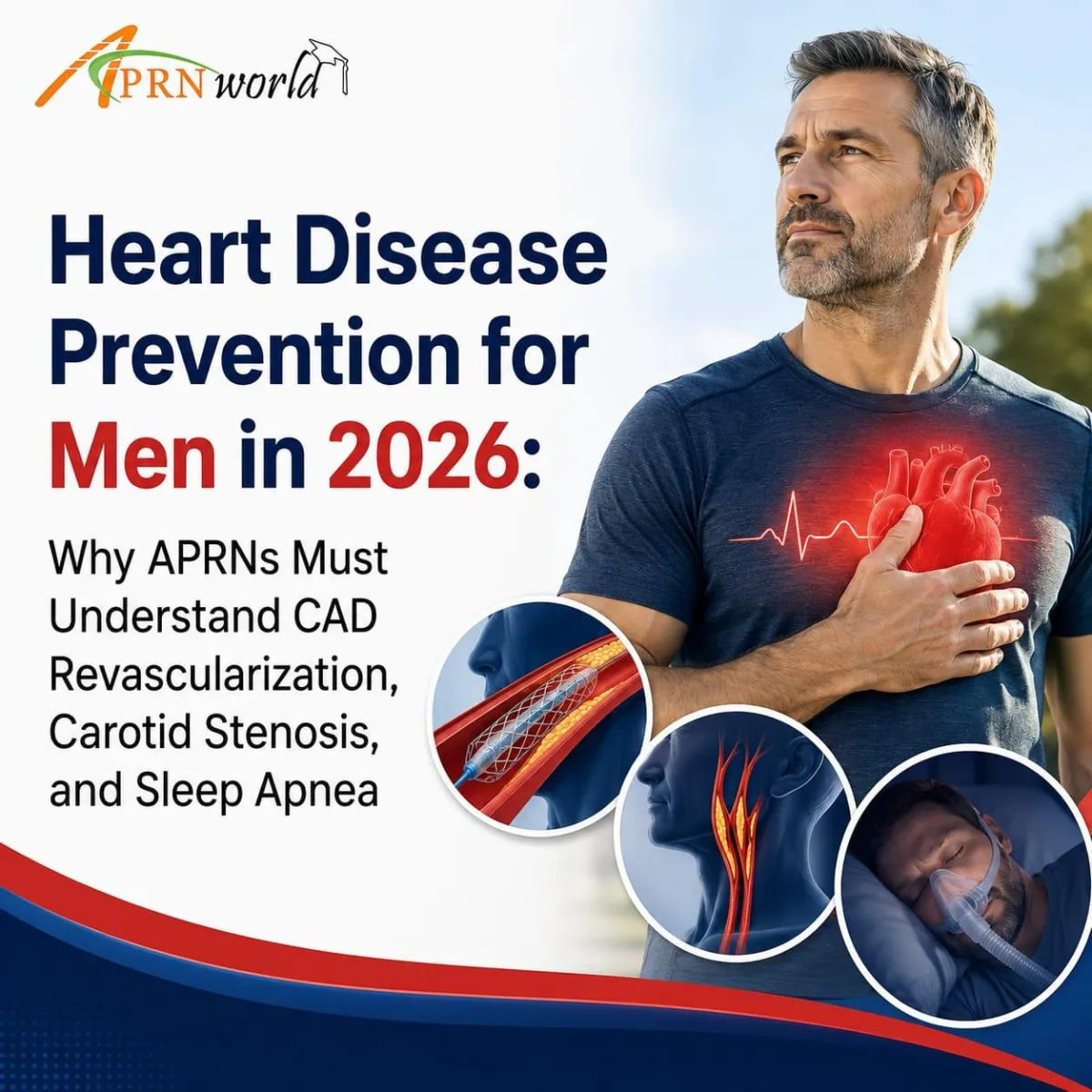
Heart Disease Prevention for Men in 2026: Why APRNs Must Understand CAD Revascularization, Carotid Stenosis, and Sleep Apnea
Heart disease remains the leading cause of death among men in the United States, accounting for approximately one in every four male deaths. Despite advances in cardiovascular care, many preventable heart attacks, strokes, and heart failure admissions continue to occur because underlying risk factors go undetected or untreated.
For Advanced Practice Registered Nurses (APRNs), prevention extends far beyond monitoring blood pressure and cholesterol levels. Today's evidence highlights the importance of recognizing the complex relationship between coronary artery disease (CAD), carotid artery disease, and obstructive sleep apnea (OSA); these three conditions that often coexist and significantly increase cardiovascular risk.
As frontline providers, APRNs play a pivotal role in early identification, patient education, risk reduction, and timely intervention. Understanding these interconnected conditions can dramatically improve outcomes for male patients and reduce long-term cardiovascular complications.
The State of Men's Heart Health in 2026
According to the American Heart Association and the Centers for Disease Control and Prevention, cardiovascular disease continues to be a major public health concern despite improvements in treatment and awareness.
Key contributors include:
Hypertension
Diabetes mellitus
Obesity
Smoking
Physical inactivity
Dyslipidemia
Sleep disorders
Chronic stress
Recent national guidance emphasizes that cardiovascular prevention must focus on identifying systemic vascular disease and associated conditions rather than treating isolated symptoms.
Coronary artery disease develops when plaque narrows or blocks coronary arteries, reducing blood flow to the heart muscle.
Men frequently present with:
Chest pain or pressure
Shortness of breath
Fatigue
Reduced exercise tolerance
Silent ischemia, especially in patients with diabetes
When symptoms persist despite optimal medical therapy or when significant coronary obstruction exists, revascularization becomes an important treatment consideration.
Percutaneous Coronary Intervention (PCI)
PCI utilizes balloon angioplasty and stent placement to restore blood flow.
Advantages include:
Minimally invasive approach
Faster recovery
Effective symptom relief
Reduced hospitalization time
Coronary Artery Bypass Grafting (CABG)
CABG remains the preferred option for many patients with:
Left main coronary artery disease
Complex multivessel disease
Diabetes with extensive coronary involvement
Recent guidelines from the American College of Cardiology and American Heart Association continue to emphasize a patient-centered "Heart Team" approach when selecting between PCI and CABG, ensuring decisions are individualized based on anatomy, comorbidities, and long-term outcomes.
Successful revascularization does not eliminate cardiovascular risk.
APRNs should continue to focus on:
Secondary prevention
Medication adherence
Lipid management
Blood pressure control
Smoking cessation
Cardiac rehabilitation participation
One of the most overlooked cardiovascular connections involves carotid artery stenosis.
Many clinicians focus primarily on stroke prevention when carotid disease is identified. However, carotid stenosis is often a marker of widespread atherosclerosis affecting multiple vascular beds.
Studies consistently demonstrate that patients with carotid artery disease frequently have concurrent:
Coronary artery disease
Peripheral arterial disease
Cerebrovascular disease
Atherosclerosis is a systemic condition, not a localized disease.
For APRNs, the discovery of carotid stenosis should trigger broader cardiovascular assessment.
Questions Every APRN Should Ask
When caring for patients with carotid disease:
Do they experience exertional chest discomfort?
Is there unexplained dyspnea?
Are cardiovascular risk factors optimally controlled?
Have they undergone recent cardiac evaluation?
Is there evidence of peripheral vascular disease?
Management should include:
Aggressive LDL cholesterol reduction
Blood pressure optimization
Antiplatelet therapy when indicated
Diabetes management
Smoking cessation counseling
Lifestyle modification
Early recognition of systemic vascular disease can help prevent both stroke and myocardial infarction.
Sleep health has emerged as one of the most important yet underrecognized cardiovascular risk factors.
According to the American Heart Association, obstructive sleep apnea affects a substantial proportion of patients with cardiovascular disease and is frequently underdiagnosed.
During episodes of apnea:
Oxygen levels fall
Blood pressure rises
Sympathetic nervous system activity increases
Inflammation worsens
Endothelial dysfunction develops
Over time, these changes contribute to:
Hypertension
Coronary artery disease
Atrial fibrillation
Heart failure
Stroke
Symptoms APRNs Should Screen For
Many male patients dismiss OSA symptoms as normal aging or occupational fatigue.
Key warning signs include:
Loud snoring
Witnessed apnea episodes
Excessive daytime sleepiness
Morning headaches
Poor concentration
Resistant hypertension
Recent American Heart Association guidance emphasizes that sleep quality, consistency, duration, and timing are all essential components of cardiovascular health.
Early identification and treatment of OSA can significantly improve cardiovascular outcomes and quality of life.
Modern cardiovascular prevention requires a comprehensive approach.
APRNs should routinely assess:
Traditional Risk Factors
Hypertension
Hyperlipidemia
Diabetes
Smoking
Obesity
Emerging Risk Factors
Sleep disorders
Chronic inflammation
Sedentary lifestyle
Psychosocial stress
Vascular Disease Indicators
Carotid stenosis
Peripheral arterial disease
Coronary artery disease
By addressing all components of cardiovascular risk, APRNs can help reduce preventable heart attacks, strokes, and hospitalizations.
Advance Your Cardiovascular Expertise with APRN World
As cardiovascular care continues to evolve, staying current with evidence-based practice is essential for every APRN.
APRN World offers affordable, clinically relevant continuing education designed specifically for nurse practitioners and advanced practice nurses seeking to strengthen their cardiovascular knowledge and improve patient outcomes.
Heart Health Courses Available at APRN World
Revascularization Strategies for CAD
Explore current approaches to PCI and CABG, patient selection, guideline recommendations, and long-term management strategies for coronary artery disease.
Carotid Stenosis – Should We Consider Heart Disease as Well?
Learn the relationship between carotid artery disease and systemic atherosclerosis, including implications for cardiovascular risk assessment and prevention.
Significance of OSA in Heart Health
Gain valuable insights into the cardiovascular impact of obstructive sleep apnea, screening recommendations, diagnosis, and evidence-based management strategies.
Why Choose APRN World?
Affordable continuing education
Evidence-based content
Expert-led cardiovascular education
Flexible online learning
Practical clinical applications
Designed specifically for APRNs and NPs
Whether you are new to cardiovascular practice or looking to expand your expertise, these courses provide actionable knowledge that can immediately enhance patient care.
Heart disease prevention in men requires more than managing cholesterol and blood pressure. Today's APRNs must recognize the important connections between coronary artery disease, carotid stenosis, and obstructive sleep apnea to provide truly comprehensive cardiovascular care.
By understanding modern revascularization strategies, evaluating systemic vascular disease, and identifying sleep-related cardiovascular risks, APRNs can play a critical role in reducing cardiovascular morbidity and mortality.
Investing in advanced cardiovascular education is an investment in better patient outcomes. APRN World's affordable heart health courses provide the knowledge and clinical confidence needed to stay at the forefront of evidence-based cardiovascular care.
Explore APRN World's cardiovascular education programs today and take the next step toward becoming a stronger advocate for men's heart health.
References
American Heart Association. Heart Disease and Stroke Statistics Update, 2025.
Centers for Disease Control and Prevention. Heart Disease Facts and Prevention Resources, 2025.
American College of Cardiology & American Heart Association. 2025 Guideline Updates for Acute Coronary Syndromes and Coronary Revascularization.
Kapur VK, et al. Obstructive Sleep Apnea and Cardiovascular Disease: Scientific Statement from the American Heart Association. Circulation.
Lawton JS, et al. 2021 ACC/AHA/SCAI Guideline for Coronary Artery Revascularization. Journal of the American College of Cardiology.
National Heart, Lung, and Blood Institute. Atherosclerosis and Vascular Disease Prevention Resources.
