


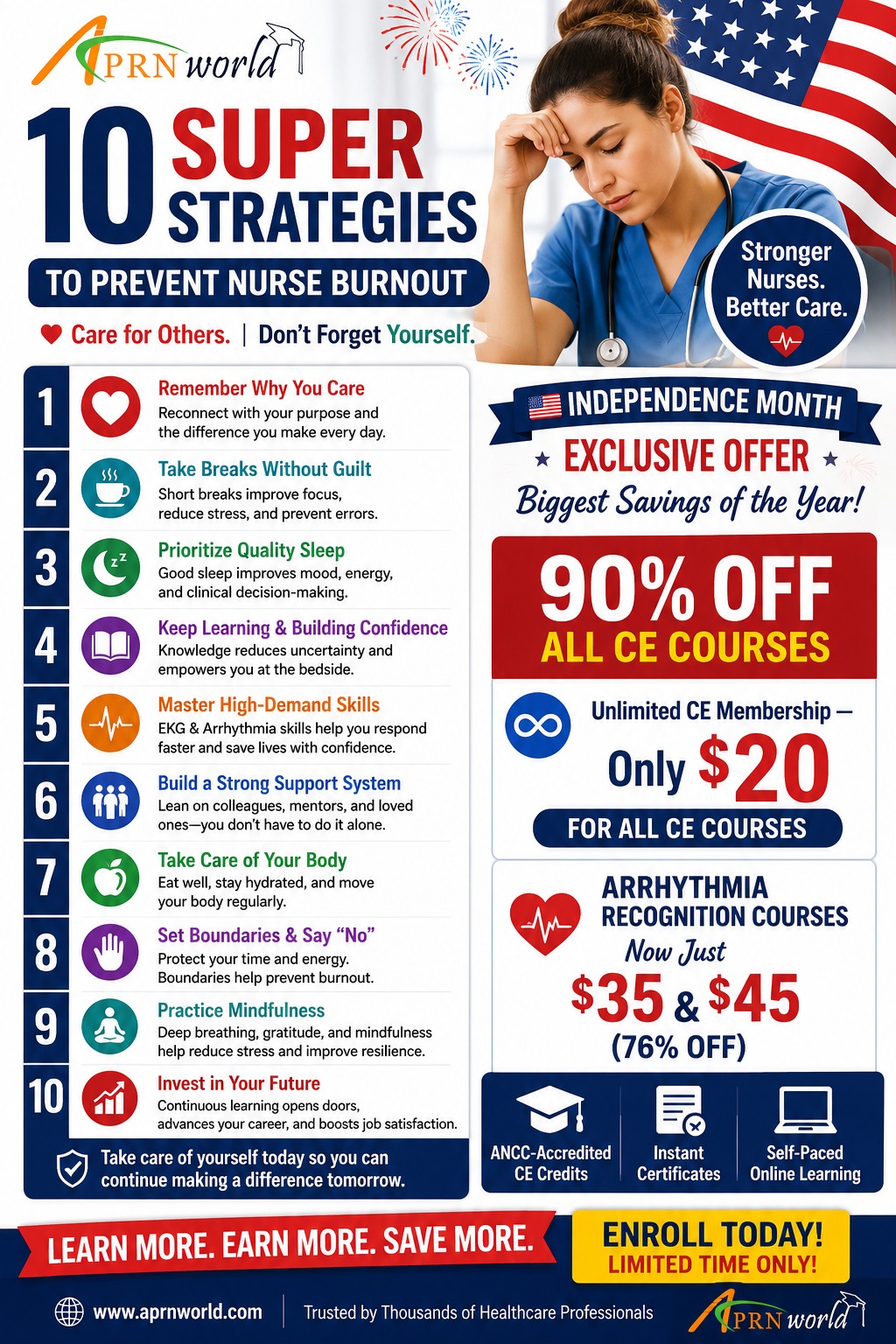
10 Super Strategies to Prevent Nurse Burnout: Protect Your Passion, Advance Your Career & Thrive in Nursing
Discover 10 evidence-based strategies to prevent nurse burnout, improve resilience, and advance your nursing career. Save 90% on ANCC-accredited CE courses and 76% on EKG & Arrhythmia courses.
You're Caring for Everyone Else… But Who's Caring for You?
As nurses, we answer call bells before our coffee gets cold. We comfort frightened families, make split-second clinical decisions, and often skip meals to ensure our patients receive the care they deserve.
One important truth we have learned throughout the years is that burnout doesn't happen because nurses stop caring. It happens because they care too much for too long without enough support.
Today, burnout is one of the biggest challenges facing the nursing profession. But it doesn't have to define your career.
The good news? Research continues to show that small, intentional changes can significantly improve resilience, reduce stress, and help nurses stay engaged in the profession they love.
Let's explore 10 powerful strategies that can help you protect your well-being while continuing to provide exceptional patient care.
Recent workforce research shows that many nurses report symptoms of emotional exhaustion, chronic stress, and compassion fatigue. Contributing factors include:
Increasing patient acuity
Staffing shortages
Extended shifts
Administrative workload
Workplace violence
Emotional trauma
Sleep disruption
Limited opportunities for recovery
Burnout doesn't just affect nurses it impacts patient safety, teamwork, job satisfaction, and healthcare outcomes.
The encouraging news is that burnout can be reduced with the right combination of self-care, workplace support, and professional growth.
10 Super Strategies to Prevent Nurse Burnout
1. Remember Why You Became a Nurse
Reconnect with your purpose.
Every patient you comfort, educate, or save is a reminder that your work matters.
Keeping a gratitude journal or reflecting on meaningful patient experiences can strengthen resilience during difficult weeks.
2. Stop Feeling Guilty About Taking Breaks
Skipping meals isn't a badge of honor.
Even a 10-minute break can improve concentration, reduce fatigue, and help prevent clinical errors.
You deserve the same care you provide your patients.
3. Prioritize Quality Sleep
Sleep deprivation affects:
Clinical judgment
Memory
Emotional regulation
Medication safety
Decision-making
Protect your sleep as seriously as you protect your patients.
4. Keep Learning to Build Confidence
One of the most overlooked ways to reduce burnout is continuing education.
When nurses feel clinically confident, they experience:
Less anxiety
Better decision-making
Greater job satisfaction
Improved patient outcomes
Confidence replaces uncertainty.
Knowledge replaces fear.
5. Master High-Demand Clinical Skills
One cardiac emergency can change everything.
That's why EKG interpretation remains one of the most valuable skills every nurse should master. Get access to APRN World’s Free EKG Simulator.
Learning arrhythmia recognition helps you:
·Recognize life-threatening rhythms earlier
·Respond confidently during emergencies
·Improve patient outcomes
·Increase your professional value
6. Build a Strong Support Network
No nurse should carry the emotional weight of healthcare alone.
Lean on:
Colleagues
Mentors
Family
Professional organizations
Asking for support is a strength, not a weakness.
7. Take Care of Your Body
Healthy nurses provide better care.
Simple habits matter:
Stay hydrated
Eat nutritious meals
Stretch between patients
Exercise regularly
Small improvements create lasting results.
8. Learn to Say "No" When Needed
Protect your energy.
It's okay to decline extra shifts when you're physically or emotionally exhausted.
Boundaries aren't selfish, they're essential.
9. Practice Mindfulness Every Day
Research suggests mindfulness practices can reduce stress, improve emotional regulation, and enhance resilience among healthcare professionals.
Just five minutes of deep breathing before or after a shift can help reset your mind.
10. Invest in Your Future
The nurses who continue learning often report greater confidence, stronger career satisfaction, and more opportunities for advancement.
Continuing education isn't simply about maintaining licensure.
It's about becoming the nurse you've always wanted to be.
Why Continuing Education Is One of the Best Investments You'll Ever Make
Healthcare evolves every day.
The best nurses never stop learning.
At APRN World, our ANCC-accredited courses help you:
·Earn CE credits
·Build real-world clinical confidence
·Stay current with evidence-based practice
·Improve patient outcomes
·Advance your nursing career
Whether you're an RN, APRN, NP, or nursing student, investing in your education is investing in every patient you'll care for in the future.
Most Popular Arrhythmia (76% Off) & CE Courses (90% Off)
Arrhythmia Courses
1.Basic EKG & Arrhythmia Recognition
2.Advanced EKG & Arrhythmia Recognition
CE Courses
·Clinical Management of NSTEMI & STEMI
·Hormones & Mental Health
·Depression: Is It a Curse or Worth Fighting?
·Gestational Diabetes Revisited
·Screening & Prevention of Cervical Cancer
…and 500+ evidence-based CE courses available with one affordable membership.
🇺🇸 Independence Month Exclusive Offer
Biggest Savings of the Year!
90% OFF ALL CE COURSES
Unlimited CE Membership — With Only $20 on CE Courses Worth $200
·Basic EKG & Arrhythmia Recognition
Now Just $35 (76% OFF) Worth $149
·Advanced EKG & Arrhythmia Recognition
Now Just $45 (76% OFF) Worth $149
Every Enrollment Includes:
a) ANCC-Accredited CE Credits
b) Instant Certificates
c) Self-Paced Online Learning
d) Mobile-Friendly Access
e) Lifetime Career Benefits
Limited-Time Independence Sale …Don't Miss Out!
Never Forget This!!
Your patients need your knowledge. Your team needs your leadership. But first, you need to take care of yourself.
Every new skill you learn, every CE credit you earn, and every step you take toward professional growth makes you a stronger, more confident nurse.
Your career is worth investing in. Your well-being is worth protecting.
Learn More. Earn More. Save More.
Enroll Today and Save 90% on 500+ CE Courses
Save 76% on Our Bestselling Arrhythmia Courses
Visit APRN World today and take the next step toward a healthier, more confident, and more successful nursing career.
References
World Health Organization. (2019). Burn-out an "occupational phenomenon": International Classification of Diseases (ICD-11).
https://www.who.int/news/item/28-05-2019-burn-out-an-occupational-phenomenon-international-classification-of-diseasesAmerican Nurses Association. (2024). Addressing Nurse Fatigue to Promote Safety and Health.
https://www.nursingworld.org/practice-policy/work-environment/health-safety/fatigue/National Academy of Medicine. (2022). National Plan for Health Workforce Well-Being.
https://nam.edu/programs/clinician-resilience-and-well-being/National Council of State Boards of Nursing. (2023). The 2023 National Nursing Workforce Study.
https://www.ncsbn.org/workforceAmerican Association of Critical-Care Nurses. (2023). Healthy Work Environment Standards.
https://www.aacn.org/nursing-excellence/healthy-work-environmentCenters for Disease Control and Prevention. (2024). Stress at Work.
https://www.cdc.gov/niosh/topics/stress/Agency for Healthcare Research and Quality. (2023). Patient Safety Network: Provider Burnout.
https://psnet.ahrq.gov/
